

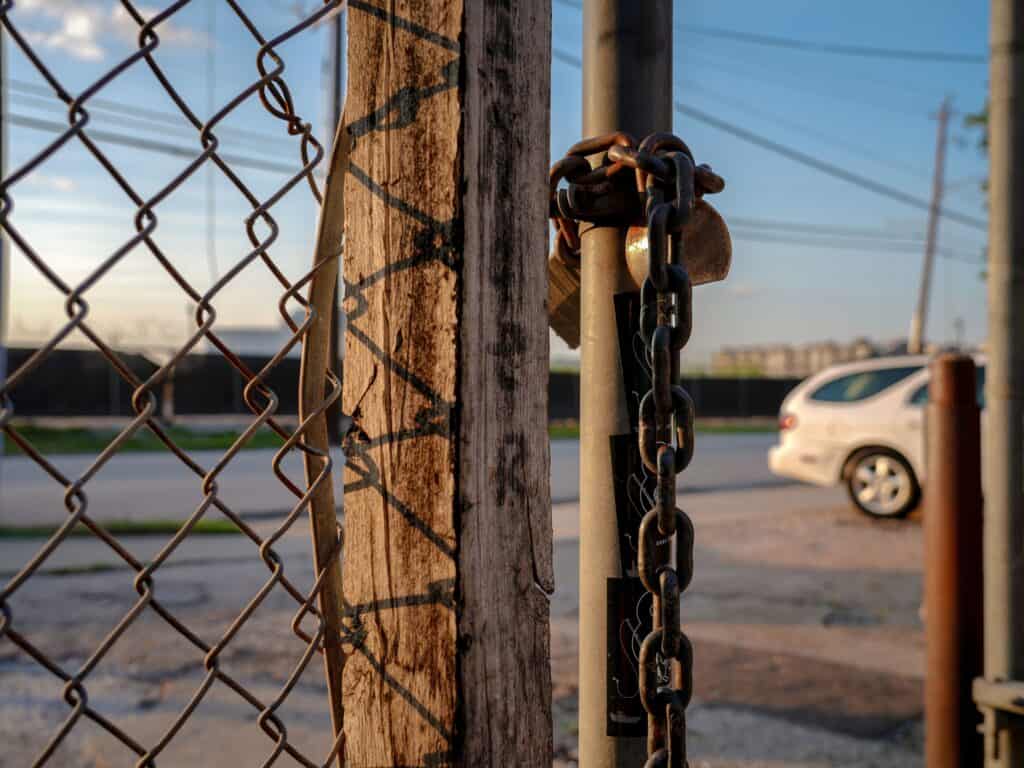
Data center perimeters are secured in layers, typically combining high-security fencing, controlled vehicle gates, vehicle barriers where the risk calls for them, perimeter intrusion detection, and access control that manages and records entry. Data center perimeter fencing forms the physical boundary around equipment and infrastructure that support continuous operation. The other layers control openings, detect attempted breaches, and manage authorized access. DK Security Solutions builds, automates, and maintains the physical fence and gate systems that support those broader security plans.
What Threats Should Data Center Physical Security Address?
Data center physical security has to account for several different types of access and disruption. Unauthorized entry can put equipment, copper, cabling, and other assets at risk, while intentional damage to power, cooling, or communications infrastructure can affect operations beyond the point of entry itself. Vehicle approaches may create another exposure where a road, driveway, or gate provides a direct path toward critical equipment or occupied areas.
That threat profile is why perimeter planning usually starts with the site rather than a standard fence specification. The goal is to identify how people and vehicles could reach the property, what they could reach after entering, and how each perimeter element can deter, delay, control, or document that movement.
How Does Data Center Perimeter Fencing Work as a Layered System?
The fence line provides the continuous physical boundary. Depending on the site’s threat level and visibility needs, that may include anti-climb 358 mesh, clear-view welded mesh, hardened chain-link, or additional fence-top deterrents. Material alone does not determine the security level, so the fence has to be considered with its height, posts, foundations, adjoining gates, terrain, and the assets behind it. Our commercial security fence materials guide explains how the common systems differ, while our guide to high-security perimeter fencing covers the broader specification process.
Gates create the controlled openings in that boundary, which also makes them one of the most important points to specify correctly. A high-security fence terminating at a gate built to a lower standard simply moves the vulnerability to the entrance. The appropriate gate type depends on the opening, traffic, available space, automation needs, weather, and security requirements. Our comparison of commercial security gate types covers those differences.
How Do Detection and Access Control Fit Into the Perimeter?
A physical fence can delay unauthorized entry, but detection adds the ability to recognize an attempted breach. Perimeter intrusion detection systems, or PIDS, can be designed to alert security personnel when activity such as climbing, cutting, lifting, or other interference occurs at the fence line. PIDS is typically coordinated with the facility’s security integrator so the detection layer works with the site’s broader security platform.
Access control handles authorized movement through gates rather than attempted entry across the fence. Keypads, card readers, vehicle detection, telephone entry, and connected gate controls can determine when a gate opens and create a record of access activity. Remote gate status and control through an access platform can also help facility teams manage entry points as part of the larger perimeter system.
What Standards and Client Requirements Shape Data Center Perimeters?
There is no single fence type, height, mesh pattern, or crash rating required for every data center. Requirements are normally shaped by the operator’s risk assessment, customer and tenant expectations, insurance requirements, local codes, and any contractual security criteria that apply to the site. ISO/IEC 27001:2022 is relevant at the information-security level because Annex A 7.1 calls for physical security perimeters to be defined and used around areas containing information and associated assets. That does not prescribe a particular fence product. It establishes the need for a physical boundary appropriate to the information and assets being protected.
For contractors, data center expectations also extend beyond what gets installed on opening day. Gate systems need to operate reliably under repeated use, and maintenance work has to be planned without unnecessarily weakening the perimeter. Redundancy may be required for power, operators, controls, or entry procedures depending on the facility’s design. Owners may also expect clear as-built documentation, commissioning records, safety testing, and ongoing maintenance records so the physical perimeter can be managed as an operational system rather than a one-time construction project.
Why Do Data Centers Use Specialized High-Security Contractors?
Data center projects bring fencing, structural gates, automation, safety devices, access control hardware, and sometimes crash-rated systems together at the same perimeter. A contractor that understands only one of those pieces can create coordination problems where they meet. DK Security Solutions handles core fence, gate, automation, and associated electronics work in-house and has CGAT and CGAD credentialed personnel through the American Fence Association. DK also installs crash-rated slide gates, swing gates, beam barriers, and bollards tested to Department of State and ASTM standards. The company performs nationwide installation and provides 24/7 fence and gate repair and maintenance.
Automated gates add another layer because security requirements do not replace gate safety requirements. DK Security Solutions’ automated gate installations comply with UL 325 and ASTM F2200, which address gate operators, entrapment protection, gate construction, and related safety conditions. The guide to UL 325 and ASTM F2200 explains how those standards work together. For teams evaluating contractors for a new site or perimeter upgrade, our high-security fencing contractor checklist covers the broader questions to ask about qualifications, installation experience, documentation, and long-term service.
How Do the Perimeter Security Layers Work Together?
The strongest data center perimeter is designed as a connected system rather than as a collection of independent products. The fence establishes and delays crossing of the boundary, while a PIDS can alert the security operation when someone interferes with that line. Vehicle gates create the authorized openings and tie into gate access control systems that determine who can enter. Where the risk assessment identifies a significant vehicle threat, crash-rated barriers and gates can protect that approach.
Integration also has to preserve safe operation. Automated gates need the required entrapment protection and safety devices even when the surrounding perimeter is designed for a high threat level. Those devices, gate operators, vehicle detection, access controls, and adjoining fence should therefore be considered during the same design process. Our fence and gate installation services bring those physical components together from site assessment through installation and commissioning.
Start With a Free Consultation
A data center perimeter should reflect the site’s actual threat profile, traffic, operating requirements, and surrounding conditions rather than a generic security specification. DK Security Solutions designs, installs, automates, commissions, and maintains high-security fencing and gate systems for data centers and other critical facilities nationwide. Contact DK Security Solutions to discuss a new data center perimeter or an upgrade to an existing fence and gate system.