

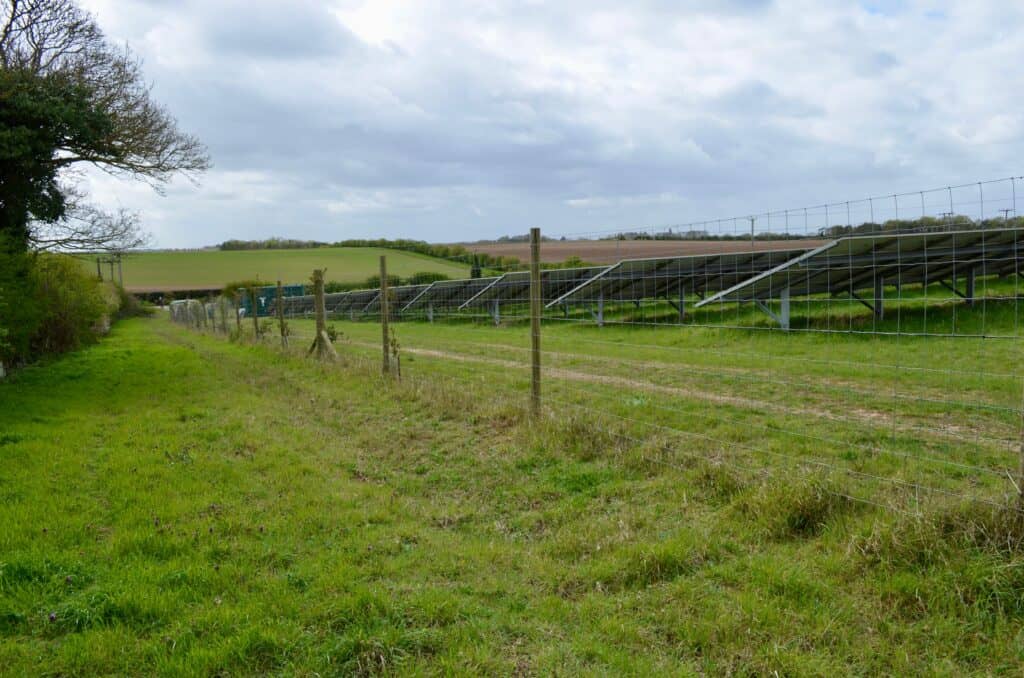
Securing a solar farm perimeter takes more than solar farm security fencing alone. Properly specified fencing needs to work alongside stronger barriers around high-value equipment, remote intrusion detection, and controlled vehicle access. The challenge is protecting a large, often unmanned property without making fencing and maintenance costs excessive. With copper theft posing a serious threat to solar installations, developers and asset managers need to consider both how long a perimeter can resist intrusion and how quickly someone can respond. DK Security Solutions designs and installs high-security perimeter fencing and gate systems for commercial and industrial sites nationwide.
Why Solar Farms Are Harder to Secure Than Other Commercial Sites
Solar farm security presents a different set of challenges than protecting a data center, warehouse, or industrial facility. Utility-scale installations often cover hundreds of acres, operate with little on-site personnel, and contain valuable electrical equipment spread across the property. The perimeter must be economical enough to cover that distance while providing meaningful protection against theft and unauthorized access.
-
Remote, Unmanned Locations
Many utility-scale solar farms are located in rural areas where land is available, but nearby security resources are limited. Operations and maintenance crews visit for scheduled work, inspections, and repairs, but there may be no personnel on the property overnight or during weekends. An intruder who enters an unoccupied site may have considerable time before anyone notices.
Distance also affects response. Even when an intrusion alarm is triggered, law enforcement or contracted security personnel may need to travel a significant distance to reach the property. A security plan that depends entirely on someone discovering a damaged fence during the next inspection leaves a considerable gap between the intrusion and the response.
-
Miles of Perimeter, Not Feet
A utility-scale solar installation may require several miles of perimeter fencing, depending on the acreage, property boundaries, terrain, and arrangement of its arrays. Fence lines may cross uneven ground, drainage areas, and access roads. Each condition affects installation and long-term maintenance.
At that scale, even relatively small specification changes can have a major effect on the total project budget. Heavier wire, closer post spacing, more substantial foundations, and additional security features all add cost when applied over thousands of linear feet. Solar developers and EPCs must evaluate security performance alongside installation cost, maintenance requirements, and the useful life of the system.
-
Copper and Equipment Theft
Copper theft is particularly damaging because the financial consequences can greatly exceed the value of the material stolen. In December 2023, thieves removed more than $100,000 worth of copper wiring from a solar installation in Fresno County, California. The Fresno County Sheriff’s Office estimated that damage to the facility could reach $2.8 million.
Those losses reflect more than replacing wire. Theft can damage electrical components, require extensive repair labor, and interrupt generation while the affected equipment is inspected and returned to service. Intruders also do not necessarily attempt to climb a fence. In a February 2026 case in Bladen County, North Carolina, deputies investigating copper theft at a solar farm found that the fence had been cut. A perimeter security plan must account for deliberate cutting as well as climbing and unauthorized gate entry.
Fencing Options That Balance Coverage and Cost Over Long Runs
Choosing solar farm security fencing begins with identifying the protection required at different parts of the property. Chain-link remains a practical option for long perimeter runs, while substations and other high-value equipment areas may justify more substantial barriers. The goal is to meet applicable requirements and establish a consistent baseline without specifying the most expensive fencing system around the entire site.
-
Start With the Code and Permit Baseline
Before selecting fencing materials, confirm the electrical code and local permitting requirements that apply to the project. NEC Section 110.31 addresses enclosures for electrical installations over 1,000 volts that are accessible to unqualified persons. It requires a fence at least 7 feet tall, or at least 6 feet of fence fabric with an extension of at least 1 foot using three or more strands of barbed wire or equivalent. The requirement applies to covered electrical installations, not automatically to every foot of a solar property’s outer boundary.
Local solar ordinances can impose additional requirements for fence height, setbacks, visibility, and permitted security toppings. Some jurisdictions restrict razor wire even when barbed wire is allowed. Developers should confirm requirements with the authority having jurisdiction early in design, including which NEC edition applies. Fence grounding and bonding also require coordination with the electrical designer. These decisions should be resolved before the fencing specification goes out for bid.
-
Hardened Chain-Link for the Long Runs
Chain-link fencing is often the most practical material for covering a solar farm’s outer perimeter. It provides a visible boundary, accommodates changing terrain, and generally costs less than welded-mesh security panels over comparable distances. Standard commercial chain-link, however, may not provide sufficient resistance where deliberate intrusion is a concern.
A hardened chain-link specification can include heavier-gauge wire, smaller mesh openings, closer post spacing, substantial footings, bottom tension wire or buried fabric, and permitted security toppings. Each feature improves resistance to climbing, cutting, or lifting the fence. These details should be specified together rather than evaluating the fabric alone. Our commercial security fence materials guide explains how chain-link and other materials compare for industrial applications.
-
Upgrade the Segments That Matter Most
Not every part of a solar installation carries the same risk. Substations, inverter and collection areas, O&M buildings, and equipment storage yards may warrant more substantial fencing because an intrusion there can damage critical infrastructure. These locations are candidates for welded-mesh systems, including 358 mesh, or other higher-security configurations.
Welded 358 mesh uses openings approximately 76.2 by 12.7 millimeters with 4-millimeter wire. The narrow openings are designed to make finger and toe purchase difficult and restrict access for conventional bolt-cutter jaws. This makes it appropriate for locations that require greater intrusion resistance, although its installed cost generally exceeds basic chain-link. Concentrating these upgrades around critical assets allows a project to maintain economical coverage across its long outer boundary while providing additional protection where a breach could cause the greatest operational disruption.
-
Detection for Remote, Unmanned Perimeters
A fence provides a physical barrier, but it cannot alert an operator when someone cuts through it. For remote solar farms, detection closes the gap between a breach and the next site visit. Detection systems help identify an intrusion while it is happening, allowing the response process to begin promptly.
-
Fence-Mounted and Ground Sensors
Fence-mounted vibration sensors and fiber-optic detection systems can identify disturbances associated with cutting, climbing, or tampering. Rather than simply reporting that an alarm occurred somewhere on the property, appropriately designed systems can identify the affected perimeter zone. This is particularly useful when crews or responders must locate a breach along several miles of fencing.
Buried sensors and radar can provide additional coverage where fence-mounted equipment is less suitable. Radar may help identify movement across open approaches, while buried systems can detect activity near designated boundaries. Selection depends on terrain, vegetation, wildlife activity, and the site layout. Detection zones should correspond to recognizable fence sections or access points so responders can locate the reported activity without searching the entire property.
-
Video Verification and Remote Monitoring
Not every sensor alarm indicates an attempted intrusion. Wind, wildlife, vegetation, and maintenance activity can produce nuisance alarms, particularly on rural properties. Dispatching someone after every unverified signal can create unnecessary expense and eventually reduce confidence in the system.
Integrating cameras with intrusion sensors allows an alarm to trigger video for review. A third-party monitoring provider or the owner’s security operations center can assess the activity before deciding whether to dispatch personnel or contact law enforcement. This approach helps distinguish an actual breach from environmental activity and provides responders with better information about the location and nature of the event. Fencing, gates, and access control should be planned with the monitoring provider so sensor zones and camera coverage line up.
-
Access Provisions for Maintenance Vehicles
Solar farm perimeter security must accommodate the vehicles and equipment required to operate the facility. Maintenance crews, vegetation contractors, utility personnel, and major equipment deliveries all need access. Gates should be planned around those operational requirements rather than added after the fence layout is complete.
-
Gates Sized for Trucks and Equipment
Solar farm gates may need to accommodate O&M trucks, trailers, cranes, and vehicles carrying transformers or other large equipment. The opening width, turning radius, available space beside the fence, and ground conditions all influence the appropriate gate configuration. An undersized opening can complicate routine maintenance and create problems when large equipment must be replaced.
Cantilever slide gates are useful on rural properties because they travel horizontally without a ground track that can collect gravel, mud, or debris. Rolling or track slide gates may suit prepared surfaces, while swing gates can work where sufficient clearance is available. Whatever the configuration, a gate can become a weak point if specified below the security level of the adjoining fence. Our guides to commercial security gate types and cantilever gate performance in harsh weather provide more detail on these decisions.
Controlling Who Gets In
Unlike a facility with a consistent daily workforce, a solar farm may have several contractors accessing the property at different times. O&M technicians, electrical contractors, utility crews, and vegetation or grazing crews may all require entry. Shared padlocks and keys can make it difficult to determine who accessed the site or whether an individual should still have access.
Card readers, keypads with individual credentials, and remote-release systems can provide better control and maintain records of authorized entry. Credentials can be changed or revoked as contractors rotate off the project. For automated vehicle gates, the operator and physical gate must also be designed with applicable safety requirements in mind. Our guide to UL 325 and ASTM F2200 explains the standards governing automated gate operation and construction.
Planning for Large and Phased Sites
Solar developments may expand over multiple construction phases, creating additional challenges for perimeter design. A fence or gate that works for the initial operating area may interfere with future construction or require relocation when the next phase begins. Planning for expansion can reduce unnecessary replacement costs while keeping the existing site secure during construction.
Designing for Future Phases
Developers should identify potential future fence lines, gate locations, and access routes before construction begins. Conduit pathways for sensors, cameras, and access control equipment can also be planned in advance, along with power requirements for automated gates. Even when equipment is not installed during the first phase, preparing the infrastructure can reduce excavation and disruption later.
Consistent fencing and gate specifications across phases also simplify long-term maintenance. O&M teams benefit from familiar hardware, compatible replacement parts, and established inspection procedures. Security systems should be designed so new detection zones and access points can be added without replacing equipment that remains serviceable. The objective is a perimeter that can expand with the facility while keeping maintenance and operating costs manageable.
Start With a Free Consultation
DK Security Solutions designs and installs high-security perimeter fencing and gate systems for commercial and industrial facilities nationwide. Whether you are planning a new installation or expanding an existing site, our team can help evaluate fencing materials, gate locations, site conditions, and applicable requirements. Learn more about our commercial fence and gate installation services or contact DK Security Solutions to schedule a free consultation.