

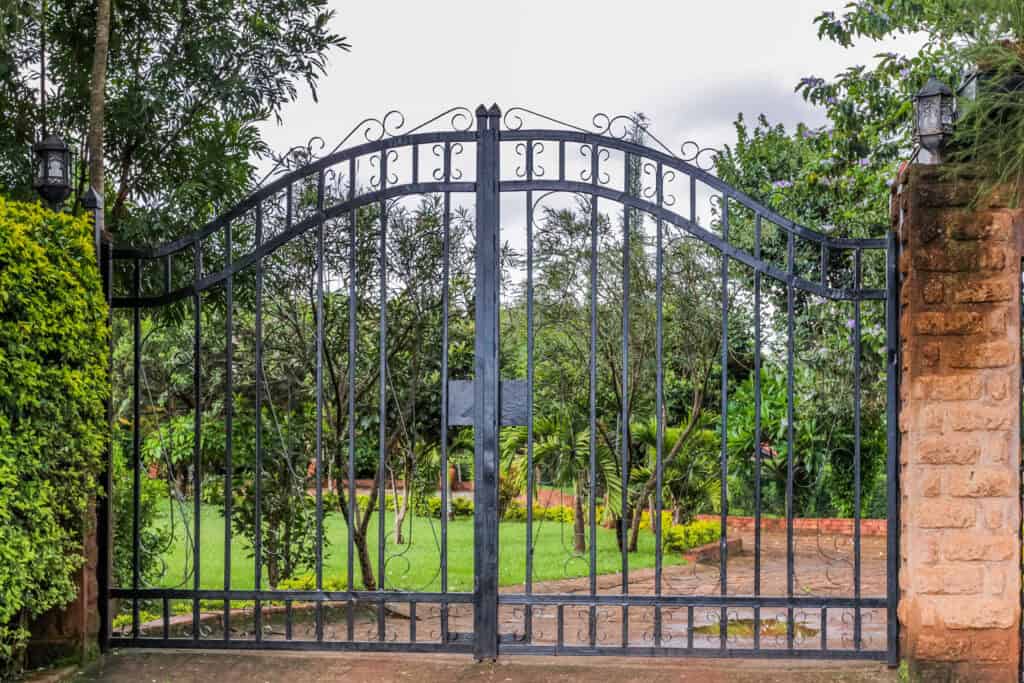
The gate is where a perimeter has to open, which makes it the hardest part of the system to get right. It has to move reliably, survive weather and traffic, and hold the same security line as the fence on either side of it. Four configurations cover most commercial and industrial applications. Two of them, the rolling slide and the cantilever slide, are horizontal slide gates that differ in how the leaf is carried, and ASTM F1184 specifically recognizes cantilever slide gates. They differ less in security level than in what the site will allow. DK Security Solutions designs, installs, and automates all four nationwide.
The Four Gate Types at a Glance
Start from the site rather than the product. Throat opening width, available space beside or behind the opening, grade, traffic volume, and climate will rule out at least one of these options before security level enters the conversation.
| Rolling/track slide | Slides horizontally on wheels running along a ground track | Level sites with a straightforward opening and steady traffic | Needs a clear track and runback space beside the opening. Track is vulnerable to snow, ice, and debris |
| Swing | Hinged leaves swing through an arc, single or double | Sites with room to swing and light to moderate cycle counts | Needs clear arc space and reasonably level grade. Solid infill increases wind load |
| Cantilever slide | Slides horizontally, suspended from rollers on posts and carried clear of the ground | Sites with snow, ice, or uneven ground where a track is a liability | Needs substantial runback space beside the opening for the counterbalance |
| Vertical pivot | Leaf pivots upward around a horizontal axis to a raised position | Tight footprints and sites with elevated security or anti-ram requirements | Needs overhead clearance and unobstructed space above the opening |
Security level is not in that table on purpose. Any of these can be built to a higher or lower standard depending on infill, frame, post and foundation design, hardware, and whether the gate is rated for vehicle impact. The mechanism decides what the site can accommodate, not how much resistance the gate provides.
Rolling/Track Slide Gates
A rolling slide gate moves horizontally on wheels that run along a track set into or onto the driving surface. It is a long-established design; the mechanism is simple, and the cost is generally lower than the alternatives at comparable size and specification.
The track is both the strength and the weakness. It carries the gate’s weight directly, which keeps the structure straightforward, but it also has to stay clear. Snow, ice, gravel, and debris in the track cause binding, drive-motor strain, and eventually failed cycles. Rolling slide gates suit level sites in milder climates or sites where the approach is regularly cleared. They are less appealing where winter maintenance is inconsistent.
Swing Gates
A swing gate hangs on hinges and travels through an arc, either as a single leaf or as a pair meeting in the middle. Nothing runs along the ground, so there is no track to keep clear, and the moving parts are few and accessible.
What a swing gate needs instead is room and grade. The arc must stay clear of parked vehicles, curbs, and rising ground along the approach. Slope is a real constraint, since a leaf that swings uphill will bind unless the design accounts for it. Wind matters too on solid or closely spaced infill, because the leaf presents a large surface with a long lever arm. Swing gates work well at lower cycle counts and become less attractive as traffic volume rises.
Cantilever Slide Gates
A cantilever slide gate travels horizontally like a rolling slide gate, but it hangs from rollers mounted on posts on one side and is carried entirely clear of the ground. Removing ground contact removes the track and, with it, the snow, ice, and debris problems that affect track-mounted designs. That is why cantilever slide gates are common on industrial sites, in northern climates, and anywhere the driving surface is uneven.
The trade is space. A cantilever slide gate needs a counterbalance section that extends beyond the opening, so the total run is meaningfully longer than the clear opening, and the exact figure depends on the manufacturer’s design.
Vertical Pivot Gates
A vertical pivot gate lifts rather than slides. The leaf rotates upward around a horizontal axis until it stands clear of the opening, which means the gate needs almost no space to either side. On constrained sites, that is often the deciding factor.
The design also suits higher-security applications. A gate that lifts has no ground track to attack or obstruct, and pivot designs can be built with heavy frames and substantial foundations where vehicle impact resistance is part of the specification. The constraints are overhead: clearance above the opening, and no canopies, signage, or utility lines in the travel path. Cycle speed is typically fast, which helps at controlled entry points where dwell time is a security concern.
Choosing by Site
Measure first. The clear-throat opening sets the size of the problem, and the available space beside or above the opening usually narrows the field to one or two options before anything else is considered. After that, weigh traffic volume, because cycle count drives wear and pushes the decision toward designs with fewer ground-level failure points.
Climate and security level finish the job. Reliable snow and ice argue against a ground track, which is the main reason cantilever slide gates displace rolling slide gates in northern markets. An elevated threat model argues for a gate specified alongside the fence rather than after it, which is covered in our commercial security fence materials guide. Automation and access control should be addressed simultaneously, and our guide to gate access control options walks through the options. Whichever type you land on, automated gates fall under published safety standards and need regular service to stay compliant and reliable.
Why Work With DK Security Solutions
Matching a gate type to a site is easier with a contractor who installs all four and has no reason to steer you toward one. DK Security Solutions handles design, installation, gate automation, and ongoing maintenance in-house, with Certified Gate Automation Technicians and Designers on staff and direct experience across utilities and substations, data centers, correctional facilities, and industrial sites nationwide.
Start With a Free Consultation
See the full scope of what we build on our commercial fence and gate installation page, or get in touch to schedule a free consultation. We will measure the opening, review the site constraints, and recommend a gate type that you can include in a specification.