

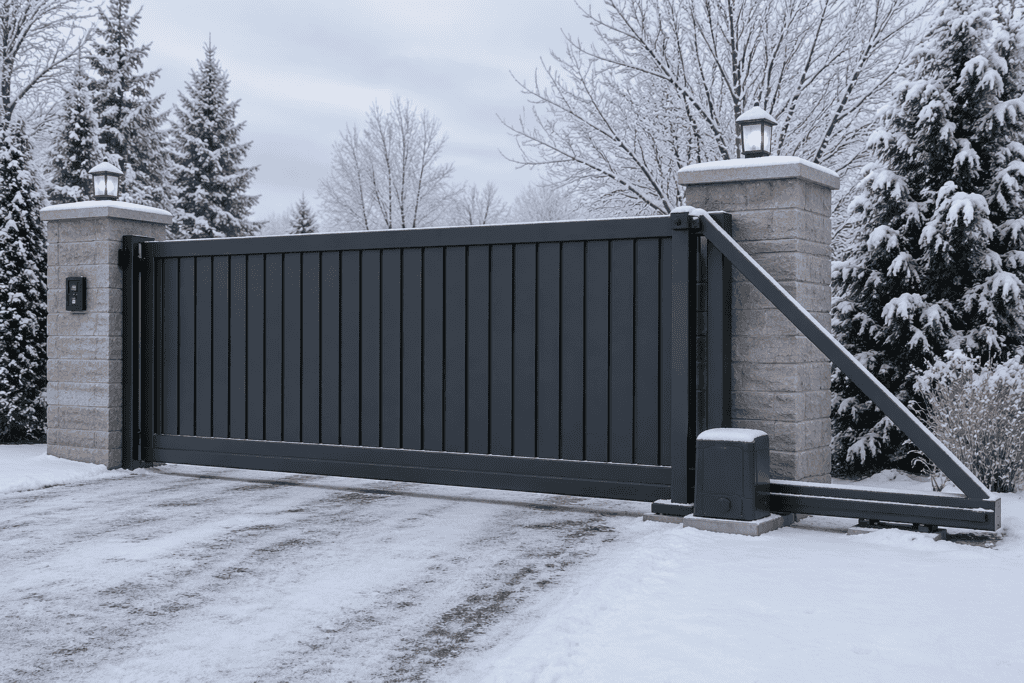
In a northern climate, winter does not give commercial gate systems much grace. Snow accumulates, ice forms in places you would not expect, and the temperature swings between a January thaw and a hard freeze can stress mechanical components in ways that only become obvious when the gate stops working. Cantilever gates were not designed with winter specifically in mind, but the way they are built makes them far better suited to it than any other gate style on the market.
No Ground Track Means No Track to Freeze
The most common failure point for roller gates in winter is the ground track. Snow and ice pack into that channel, and once it freezes solid, the rollers have nowhere to go. The gate either grinds to a halt or the operator burns itself out trying to force it through. Even regular maintenance cannot fully prevent this because the problem resets every time it snows.
A cantilever gate has no ground track at all. It rides on rollers mounted to posts on either side of the opening, and the gate itself glides across that span without touching the ground. There is nothing at grade level for ice to fill, nothing for snowpack to block, and no channel that requires clearing before the gate will move. That single design difference eliminates the most common reason commercial gates fail in winter.
Sealed Bearings Hold Up Where Open Hardware Does Not
The rollers and carriages on a cantilever gate rely on bearings to move smoothly, and the quality and construction of those bearings matter considerably in cold weather. Bearings that are open to the elements collect moisture, and that moisture freezes. When it does, the bearing seizes, the gate drags, and the operator works against resistance it was not built to handle indefinitely.
Properly specified cantilever gate hardware uses sealed bearings that keep moisture out regardless of the conditions outside. They are also rated to function across a wide temperature range, so the lubricant inside does not thicken and slow things down when temperatures drop well below freezing. This is one of the areas where hardware quality and climate performance are directly connected, and it is something worth asking about when you are comparing gate systems or getting bids on an installation.
Linear Travel Clears the Opening Without Fighting the Ground
Swing gates rely on an arc of travel that sweeps across the ground surface in front of or behind the fence line. When that ground is covered in snow or rutted from traffic, the gate cannot complete its arc. It catches on whatever is in its path, and the operator stalls or the gate bends at the hinge point under enough force. This is a recurring problem on active commercial sites where plowing and foot traffic leave the grade in front of a swing gate anything but clean.
A cantilever gate travels in a straight, horizontal line parallel to the fence. It does not sweep the ground; it does not depend on a clear pavement to complete its travel; and it does not have a hinge point at grade level that can heave or shift with frost. The opening clears fully regardless of what is happening at ground level, which is exactly what a commercial site needs when a delivery truck is waiting, and the pavement is a mess. That reliability is not a seasonal feature; it is built into how the gate works every single day of the year.
Why Operators Last Longer on Cantilever Systems
A gate operator is only as reliable as the gate it is moving. When a swing gate catches on snow, or a roller gate grinds through a frozen track, the operator absorbs that resistance. Over time, the repeated strain shortens the life of the motor, the gearbox, and the control board. Service calls and early replacements become part of the operating cost of the gate system, whether the owner connects them to the gate design or not.
On a cantilever gate with quality hardware, the operator moves a gate that rolls freely on sealed bearings along a clear path. The load is predictable, the resistance is minimal, and the operator works the way it was designed to work rather than compensating for a gate that is fighting the weather. Operators on well-installed cantilever systems routinely outlast those on swing or roller gate systems in comparable applications, and the difference is especially pronounced on sites in climates where winter conditions are severe and prolonged.
What to Look for in a Cold-Climate Cantilever Installation
Not every cantilever gate installation is equal, and the details matter more in a northern climate than they do in a mild one. Post depth and footing size need to account for frost heave, which can shift posts that were set too shallow and throw the gate out of alignment over a few seasons. The counterbalance on the back end of the gate needs to be proportional to the gate weight so the system stays level even as components expand and contract with temperature changes.
Hardware selection, post gauge, and operator sizing all contribute to how the system performs once winter arrives. An installer who understands cold-climate requirements will account for these factors during the design phase rather than treating them as adjustments to be made after the fact. At DK Security Solutions, we install cantilever gates across sites that see real northern winters, and building for that environment is part of how we approach every project from the first site visit forward.
Work With a Commercial Fencing Contractor You Can Count On
DK Security Solutions has been installing commercial fencing and gate systems for facilities across the region for decades. Contact us to talk through your project with a team that manages every job in-house, from the first site visit through final installation. Whether you are securing a new facility, replacing aging infrastructure, or expanding an existing perimeter, we bring the experience to ensure it is done right the first time.