

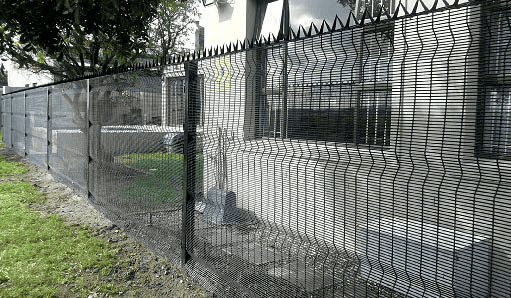
When you look at the fence surrounding a prison, a military base, or a power substation, it does not look like a typical chain-link fence. The mesh is tighter, the wires are heavier, and there is simply no foothold to grab or toehold to push off. That is anti-climb fencing, and the engineering behind it is more deliberate than it might appear.
What Makes a Fence Anti-Climb?
Anti-climb fencing is defined by its aperture (the size of the openings in the mesh). Standard chain-link fencing has openings large enough for a person to insert their fingers and toes, which makes it climbable with very little effort. Anti-climb designs close that gap dramatically. The most common specification is 358 mesh, sometimes called prison mesh, which features openings that measure approximately 76.2mm tall by 12.7mm wide. This measurement is too narrow to grip and too shallow to support a foot.
The name “358” comes directly from those dimensions: 3 inches by 0.5 inches, with a wire 8 gauge in diameter. That combination of small apertures and heavy wire also resists cutting tools, since bolt cutters and wire snips need room to work. A fence that cannot be gripped cannot be cut easily either, which is why 358 mesh is considered a two-in-one security solution in the perimeter protection industry.
Where Is Anti-Climb Fencing Used?
The applications for anti-climb fencing follow a straightforward logic: anywhere an unauthorized breach carries serious consequences. Correctional facilities are the most widely recognized use case, and the design standards developed for those environments have since been adopted in commercial and industrial settings. Prisons require fencing that detainees cannot scale quickly, and 358 mesh became the standard because it met that requirement without relying solely on razor wire or other add-on deterrents.
Military installations, electrical substations, and data centers have adopted the same fencing for similar reasons. A substation breach, for example, can affect thousands of customers and create significant safety hazards, so the perimeter protection needs to be passive and reliable without depending on constant human monitoring. Data centers carry physical security requirements tied to compliance standards, and anti-climb fencing is one of the physical controls that satisfies those requirements.
How It Differs from Standard Security Fencing
Not all fencing marketed as “security fencing” qualifies as anti-climb. Many ornamental steel fences, welded wire panels, and even some heavy-gauge chain-link products are sold under a security label, but their apertures are large enough to allow climbing. The distinction matters because facility managers and project owners sometimes assume that a heavier or taller fence automatically provides anti-climb performance. Height adds time, but it does not eliminate the ability to climb.
True anti-climb fencing is evaluated first by aperture size, then by wire gauge, then by overall height. A six-foot panel of 358 mesh will outperform a ten-foot panel of standard chain-link from a climbing-resistance standpoint. That said, height, anti-climb fencing, and additional deterrents like fence-top extensions are frequently combined at high-security sites because no single measure is treated as sufficient on its own.
What to Look for When Specifying Anti-Climb Fencing
Specifying anti-climb fencing for a project requires attention to the mesh designation, the wire gauge, and the coating or finish. The 358 designation is the recognized benchmark, but some manufacturers produce proprietary mesh patterns that achieve similar aperture sizes under different names. Confirming the actual opening dimensions is more reliable than relying on a product name alone. Galvanized steel is the standard base material, and a polyester powder coat finish adds corrosion resistance and can help the fence meet color requirements for a given site.
Installation quality matters as much as the product specification. Anti-climb fencing loses much of its effectiveness if there are gaps at the base, loose tension, or poorly anchored posts. A professional fence installation ensures that the mesh is stretched correctly, the framework is set in concrete to the right depth, and any penetrations for gates or utilities are treated with the same care as the main fence line. The fence itself is only as strong as the installation behind it.
Is Anti-Climb Fencing Right for Your Project?
For most commercial properties, standard security fencing provides adequate perimeter control. Anti-climb fencing becomes the right choice when the risk profile of a site demands a higher level of passive deterrence. Utilities, critical infrastructure, and any facility that stores sensitive equipment or materials are strong candidates. So are properties that have experienced perimeter breaches in the past or that are located in areas with elevated security concerns.
If you are not certain whether your project requires 358 mesh or a similar anti-climb specification, a conversation with an experienced fence contractor is the right starting point. A qualified contractor can assess the site, review any applicable compliance requirements, and recommend a fencing system that matches the actual risk without over-building. DK Security Solutions works with commercial and industrial clients across a range of security applications, and fence installation is one of the core services we bring to those projects.
Contact DK Security Solutions Today!
Ready to secure your property with professional-grade fencing? Contact the DK Security Solutions team today to get a quote or talk through your project requirements. We work with facilities of all sizes and will help you find the right fencing solution for your site and security needs.